
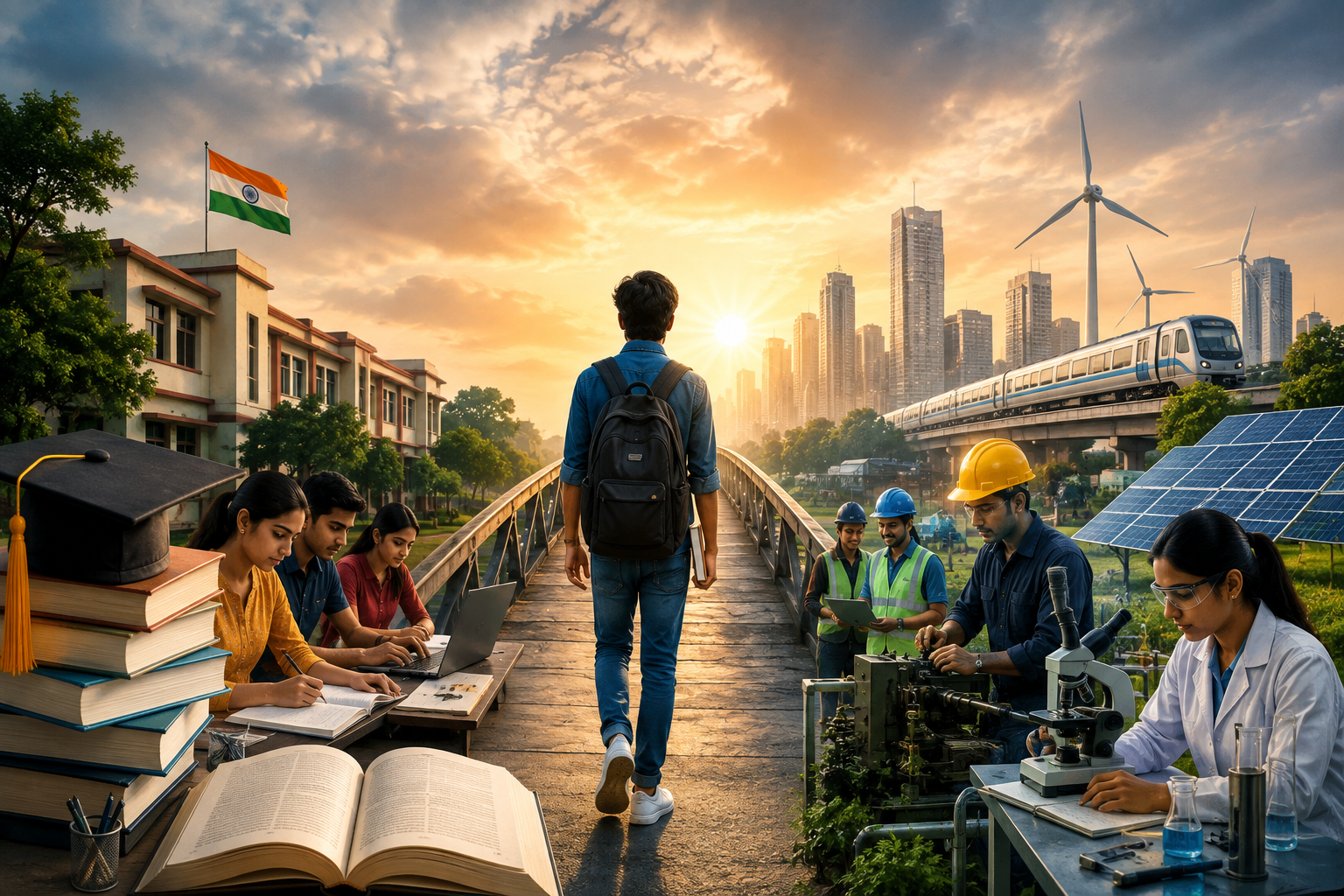
India stands at a pivotal historical moment. With over 65% of our population under the age of 35, our youth represent our greatest collective strength. Every morning, millions of students across towns, villages, and cities step into classrooms with the hope that education will unlock dignified livelihoods, financial independence, and the opportunity to contribute meaningfully to nation-building.
Yet, as someone who interacts closely with students, teachers, and young professionals every single day, one reality is unmistakably clear: the bridge connecting our education system to real-world employment is under severe strain.
Having formal degrees alone is no longer guaranteeing sustainable livelihoods. To truly honor the aspirations of our youth, policy planners and educators must come together to establish a transparent, inclusive, and forward-looking Education-to-Employment Roadmap.
1. The Paradox of Educated Unemployment
While access to primary and higher education has expanded significantly over the past few decades, the transition from classrooms to productive careers remains fragile.
-
The Employability Deficit: A significant portion of young graduates find themselves under-skilled for modern industry requirements. While theoretical knowledge is delivered, applied skills, digital literacy, and critical problem-solving often take a backseat.
-
Paper Leaks & Recruitment Delays: Irregularities in competitive exams, paper leaks, and bureaucratic delays in public recruitments have severely shaken student morale. Young aspirants spend years preparing in coaching hubs, only to face uncertainty.
-
The Squeeze on the Informal Sector: Without structured institutional pathways into the formal economy, millions of qualified young minds are forced into precarious, low-paying informal jobs.
Nation-building cannot happen when youth potential is left stranded in limbo. True progress demands systemic transparency, institutional integrity, and predictable career pathways.
2. Strengthening Public Education as the Foundation of Equality
A progressive nation is built on the bedrock of accessible, equitable public education. As championed during the visionary tenures of India’s foundational leaders—from establishing premier institutions like the IITs, IIMs, and AIIMS under Pandit Jawaharlal Nehru to igniting the telecom and IT revolutions under late Prime Minister Rajiv Gandhi—public investment in human capital has always yielded India’s highest returns.
To recreate that transformative momentum today, our policy priorities must refocus on:
A. Protecting the Integrity of the Examination System
Restoring trust among students requires strict legal safeguards, end-to-end technological transparency, and zero tolerance for malpractices in recruitment examinations. Young minds must know that their hard work and merit will be respected without compromise.
B. Upgrading Curriculums for Industry 4.0
Textbooks must evolve alongside global technological shifts. From green energy and data fundamentals to advanced vocational trades, secondary schools and colleges need modern labs, practical apprenticeships, and direct linkages with local industries.
C. Dignity for Vocational Training
Vocational education must no longer be treated as an alternative for academically struggling students. Structured skill tracks should be integrated directly into secondary schooling, complete with credit transfer systems and recognized industry certifications.
3. A Three-Pillar Framework for Sustainable Youth Empowerment
To turn our demographic dividend into an engine of inclusive growth, a holistic framework based on constitutional values of fairness and equal opportunity is essential:
-
Foundational Trust: Eliminate exam cancellations and delays by making recruitment bodies fully accountable and time-bound.
-
Practical Skilling: Guarantee paid apprenticeship programs and practical mentorship across public and private sectors for young graduates.
-
Equal Opportunity: Ensure that students from marginalized, rural, and minority backgrounds receive targeted scholarship support, accessible digital infrastructure, and equal access to career counseling.
4. The Moral Responsibility of Leadership
Empowering the youth is not a partisan matter; it is a constitutional and moral imperative. When a young student loses faith in the fairness of an examination system, or when an educated graduate struggles for basic dignity, society as a whole suffers.
Our role as educators, social workers, and public representatives is to be the voice of these young aspirations. We must advocate for policies that invest in teachers, modernize classrooms, foster critical thinking, and ensure that economic growth creates meaningful, dignified jobs for every willing pair of hands.
The Way Forward
India’s destiny will be written by the young people sitting in our classrooms today. If we equip them with quality education, modern skills, and a transparent system that rewards genuine merit, there is no limit to what our nation can achieve.
The time has come to move beyond fragmented announcements and implement a unified Education-to-Employment Roadmap—one that restores hope, delivers justice to our students, and secures an inclusive future for all.
